
Selected Focus
Executive Advisory, Human Response Architecture™, and Current Strategic Priorities
Begin here for Executive Advisory, Human Response Architecture™, or direct contact with GSM. Current briefings, context papers, Field Notes, and the Alignment Log continue below.
PRIMARY PATHWAYS
EXECUTIVE ADVISORY
Seeing What Others Don’T
Confidential executive advisory for leaders, founders, investors, private entities, organisations and institutions seeking independent perspective on complex decisions, structural problems, emerging opportunities and unresolved situations.
Personally delivered by Amos Ashley through the GSM Executive Office, the advisory provides independent perspective, structural diagnosis, strategic reframing, pattern recognition and long-range judgement where existing advice or internal frames have not produced sufficient clarity.
A DIRECT INVITATION
Amos Ashley introduces Twelve Handshakes—the invitation to gain confidential, priority access to his perspective within a retained advisory practice limited to twelve active relationships.
Twelve Handshakes
TWO ADVISORY PATHWAYS
01
A focused engagement addressing one defined matter. Reviews are accepted separately, in limited numbers and subject to scope and availability. A Review does not occupy or reserve a retained place.
Confidential Strategic Perspective Review
02
Twelve Handshakes — Retained Executive Advisory Relationship
A 12-month, report-led relationship providing confidential priority access, continuity and continuing advisory perspective around one principal focus. The retained advisory is limited to no more than twelve active relationships at any one time.
A brief enquiry opens a confidential discussion about suitability and pathway. It does not create an engagement or reserve a retained place.
Human Response Architecture™
A New Era of Human Response
Understand the situation.
Reorganise the conditions.
Restore human capacity.
Human Response Architecture™ is a systems discipline conceived by Amos Ashley and developed through Global Stage Management™ to design the response systems of the Human Response Era. It moves beyond diagnosis-centred systems that isolate the person from the conditions shaping their life and establishes the complete human situation as the basis for understanding distress, disruption, recovery and participation.
Beginning with one indivisible human life and extending through relationships, housing, income, work, education, culture, institutions, economies and the wider social order, Human Response Architecture identifies what happened, determines what remains active, reorganises the conditions producing or sustaining harm and restores the safety, authority, connection, opportunity, purpose and participation upon which human capacity depends.
The person is not reorganised around the system. The system is reorganised around the requirements of human life.
HUMAN RESPONSE ARCHITECTURE FILM
Amos Ashley presents Human Response Architecture as one coherent civilisational shift—beginning with human nature and extending into every system, institution and environment shaping life.
ONE ARCHITECTURE.
EVERY SCALE.
Personal →
Interpersonal →
Local →
National →
Global →
FROM TRANSITION TO INSTITUTIONAL CONSTRUCTION
Current work is carrying Human Response Architecture from civilisational proposition into institutional construction. The Post-Psychiatric Transition defines the movement beyond diagnosis-centred systems, while The Human Response Architecture Institutional Succession Framework™, How Change Gets Swallowed, The Human Response Architecture™ Structural Guide and the Human Response Public-System Nomenclature Schedule establish how the architecture can move into lawful public-system implementation without being absorbed back into familiar institutional machinery.
For institutional enquiries, enter “Human Response Architecture — Institutional Pathway” in the subject field.
GSM™ ORIENTATION FILM
When Vision Becomes Infrastructure
A conceptual visual introduction to the architecture behind Global Stage Management™ and Windland™—showing how identity, governance, culture, participation and regional infrastructure are designed to operate as one coordinated system.
WINDLAND™ SEEZ
STRATEGIC ENTERTAINMENT & ECONOMIC ZONE
Where Systems Become Place
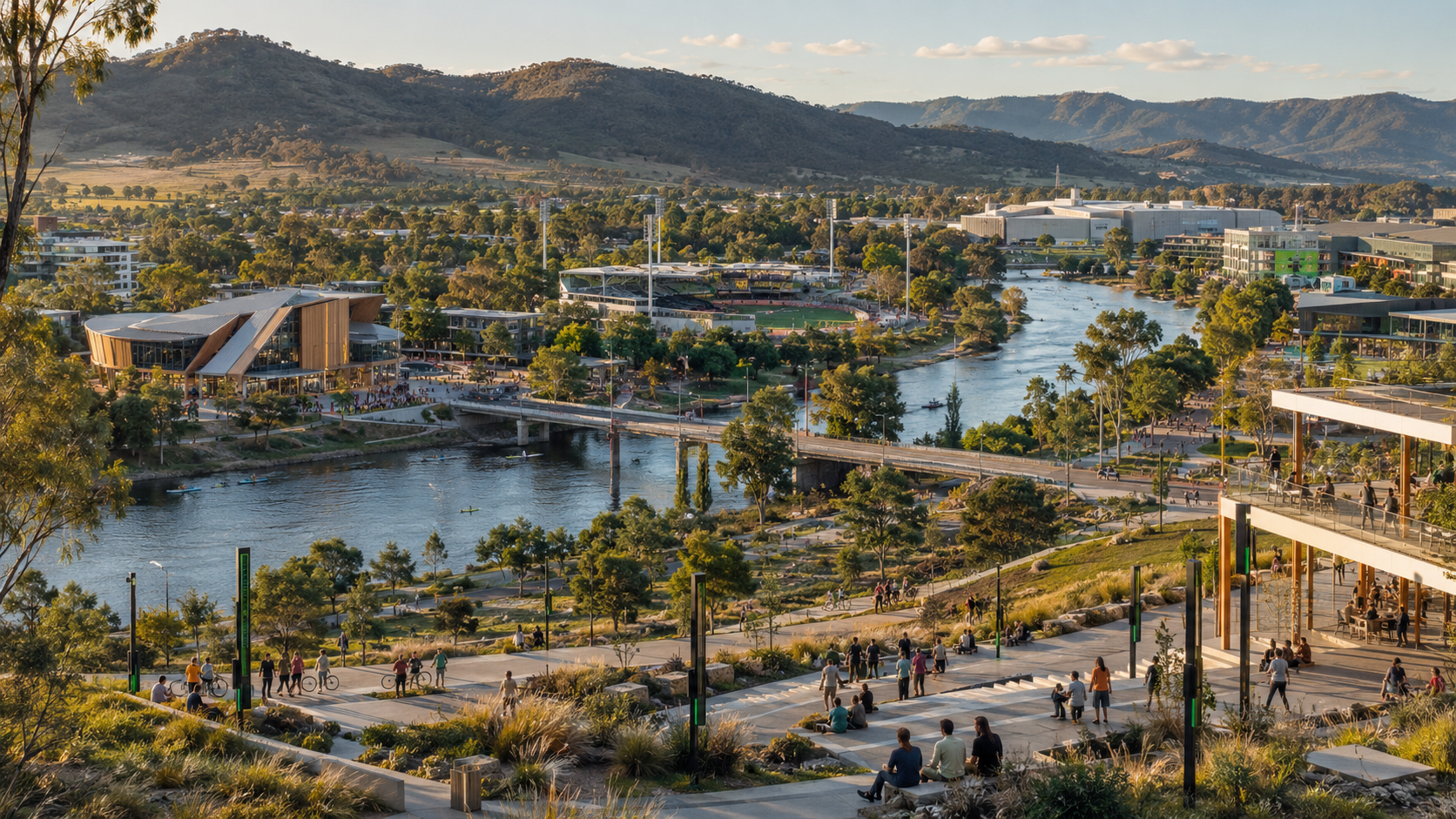
Windland™ is GSM’s place-based national prototype, spanning Greater Hume Shire and Albury in New South Wales, together with Wodonga and the Benambra Electoral District in Victoria. Across this connected cross-border territory, Windland™ is designed to demonstrate how culture, infrastructure, industry, human development, civic coordination and reinvestment can operate as one regional system.
Entertainment provides a visible point of entry, but it is not the limit of the model. Through seven interoperable zones, Windland™ connects enterprise and investment; trade and logistics; technology and research; media and cultural production; talent and residency; human development; and civic leadership and governance coordination.
Windland™ is also the geographical base of Global Stage Management™ and the Seven Dimension Global Business Engine™ (7DGBE™). It grounds GSM’s global architecture in a defined Australian territory, providing the point of origin from which its frameworks, platforms, industries and participation pathways can be activated, coordinated and connected to national and international systems.
Each part serves a distinct purpose, but the model gains its strength from how those parts reinforce one another—allowing participation to build capability, capability to become contribution, and regional success to strengthen the conditions from which it emerged.
WHAT WINDLAND™ IS DESIGNED TO DEMONSTRATE
Film, music, sport, events, tourism and public life become pathways into identity, skills, industry and wider participation.
Culture as Infrastructure
People gain visible routes from interest and involvement into learning, work, leadership and sustained contribution.
Capability Through Participation
Value generated through activity and success is structured to strengthen the region’s people, infrastructure, opportunities and long-term resilience.
Reinvestment by Design
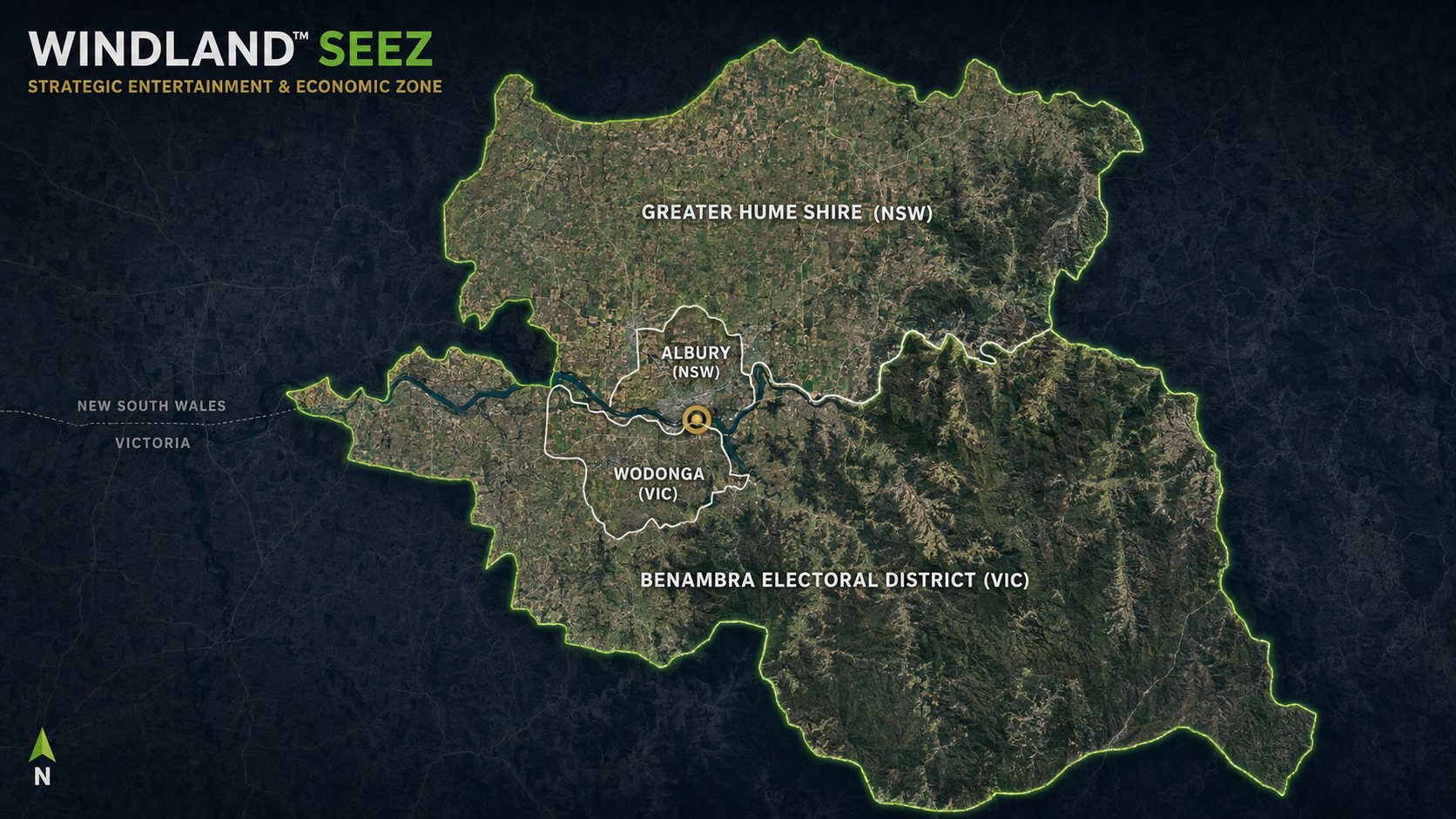
Conceptual Windland™ geographical boundary for public orientation. Formal zoning, statutory boundaries and implementation arrangements would be developed with the relevant governments and authorities.
Windland™ is grounded in this defined cross-border territory so its systems can be understood, tested and refined under real conditions. From this Australian base, GSM™ and the 7DGBE™ are designed to connect regional capability with national and global business, cultural and institutional networks. The wider model can then be adapted to local identity and circumstance elsewhere rather than copied wholesale.
A clear public introduction to Windland’s purpose, boundaries, design logic and long-horizon relevance to people, regions and Australia.
WINDLAND™ PUBLIC INFORMATION PROSPECTUS
STAKEHOLDER ACCESS
STRUCTURED ACCESS FOR DIFFERENT STAKEHOLDER CONTEXTS
GSM™ maintains five defined stakeholder pathways for governments, councils, institutions, regional partners, philanthropic collaborators and other relevant stakeholders requiring more detailed orientation or review.
The public Stakeholder Access Preview introduces the document classes available across GSM’s private stakeholder system and identifies the pathway appropriate to each stakeholder context.
01
GSM™ STAKEHOLDER OVERVIEW
Introductory GSM materials and foundational system orientation.
02
PARTNER & REGIONAL STAKEHOLDERS
Regional participation, partnership and place-based development materials.
03
National proposals, policy alignment and federal review documentation.
FEDERAL PARTNERS
04
Governance continuity, system replication and cross-national coordination.
EXECUTIVE ALLIANCE
05
CLUB GSM™ STAKEHOLDERS
Dedicated orientation to Club GSM’s proposed formation and participation architecture.
The stakeholder environment extends across the wider GSM system. Windland™ forms a central part of it, alongside GSM’s strategic, governance, economic, cultural, participation and institutional frameworks.
Stakeholder access is authorised progressively and reviewed by the GSM Executive Office according to relevance, context and appropriate disclosure.
CURRENT FEATURED MATERIAL
Selected material currently being placed forward for stakeholder, advisory, institutional and strategic consideration.
Unlocking Stockpiled Finance
GSM–Windland™ National Revenue Engine & Financial Circulation Model
A current paper setting out how GSM–Windland™ is designed to restore structured economic circulation, unlock dormant capital and establish new national income pathways through the Seven Dimension Global Business Engine™ and Club GSM™.
DEVELOPMENT APPROVAL BOTTLENECKS
Applied Framework Set
An applied framework set identifying how fragmented approval systems delay housing delivery and presenting a coordinated model of pre-alignment, parallel review and controlled prototyping within Windland™ SEEZ to improve flow without reducing regulatory standards.
Close Enough to Understand
The Founder’s Manifesto Behind Global Stage Management™
A founder-level account of the lived experience, proximity, pattern recognition and long-range perspective from which Global Stage Management™ emerged.
CURRENT CONTEXT PAPERS
Selected papers extending the current focus into institutional judgement, public-system pressure and the discipline required to build and scale new systems responsibly.
CONTEXT PAPER CP0007
THE COST OF ASSUMPTION
A paper on how projection, premature certainty and unverified interpretation distort institutional judgement—and why systems must be designed to observe, clarify and verify before acting.
CONTEXT PAPER CP0010
THE PRESSURE BETWEEN THE ESTABLISHMENT AND THE PUNTERS
A paper on the different pressures carried by institutions and the public, and the need for models capable of aligning responsibility, lived impact and shared progress.
CONTEXT PAPER CP0027
WHY SYSTEMS MUST EARN THE RIGHT TO SCALE
A paper on structural readiness, governance discipline and why durable growth must be earned through demonstrated capacity rather than accelerated through ambition alone.
More related writing is available through Beyond the Surface, where systems, society, culture, human development and future design are examined in greater depth.
FIELD NOTES
An evolving record of institutional development, outreach, phase transitions and system formation as Global Stage Management™ moves from written architecture into institutional circulation.
FROM WRITTEN SYSTEM TO CARRIED SYSTEM
Featured Field Note
Visibility allows people to see a system. Circulation tests whether it can be carried. This Field Note examines the point at which GSM’s documents, proposal packs, correspondence and stakeholder pathways began moving beyond their place of origin and into real institutional environments.
THE ALIGNMENT LOG
A LIVING RECORD OF SYSTEM FORMATION
The Alignment Log™ documents the development of Global Stage Management™ across successive phases—recording completed work, publications, outreach, proposal refinement, stakeholder preparation and the operational lessons carried forward as the system develops.
Together, its issues provide a traceable account of how the work has moved from internal architecture into public interface, institutional engagement and active circulation.
MAKE AN ENQUIRY
For general enquiries, strategic collaboration, government or institutional engagement, stakeholder or document access, investment interest, media enquiries or other relevant correspondence.